
Clear aligners
Clear aligners are a series of thin, removable plastic trays, each shaped to move your teeth a little further. You change to the next set every week or two until the teeth reach their planned position.
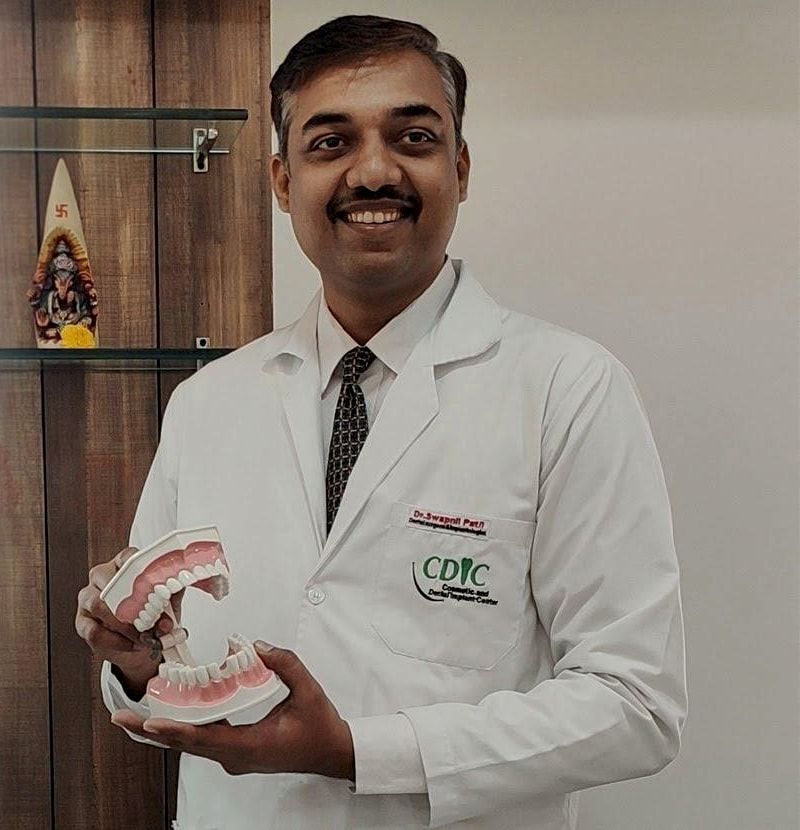
Draft, awaiting review by Dr. Swapnil B. Patil, BDS
How aligners move teeth
Each aligner is made from a thin, clear plastic, shaped to sit a fraction of a millimetre away from where your teeth are now. Worn for most of the day, it presses each tooth gently towards that next position. When the teeth have caught up, you move to the next set. A full course is a sequence of these small steps, planned in advance on a computer.
Small tooth-coloured bumps, bonded to some teeth, give the plastic something to push against for movements a smooth tooth surface cannot manage.
Your part in it
Aligners only work while they are in. The 20 to 22 hours a day is not a guideline but the condition for the plan to work: you take them out to eat and to clean your teeth, and little else. People who find that hard often do better with fixed braces or invisible braces, which work without needing to be remembered.
After the last set
Teeth that have been moved keep a tendency to return. Retainers, worn as advised, hold them while the bone around them settles, and then for the long term, usually at night.
It may suit you if
- Teeth are mildly or moderately crowded, or have small gaps
- Teeth have moved back after braces you had years ago
- You want to straighten your teeth without brackets and wires
- You can wear the aligners 20 to 22 hours a day, every day
Suitability is confirmed at your examination, never from a web page.
If you would rather wait
Straightening for appearance is never urgent, and waiting is a fair choice. If crowding is making the teeth hard to clean, or teeth that were once straight are moving, it is worth an assessment sooner, while the change is small.
Step by step
What happens at each stage, and roughly how long it takes. Your own timings are set out in your written plan.
Step 1: Scan and photographs
A scan or impressions of the teeth, photographs and X-rays show where each tooth is now and whether aligners suit your case.
Step 2: The digital plan
The movement of every tooth is planned stage by stage on a computer. You see the expected start and finish before agreeing.
The plan shows how many sets you are likely to need, and so roughly how long treatment will take.
Step 3: Your first aligners
Small tooth-coloured bumps may be bonded to some teeth so the aligners can grip them. You are shown how to put the trays in, take them out and clean them.
Step 4: Changing sets and checks
You move to the next set every one or two weeks, and visit for checks so we can confirm the teeth are tracking the plan.
Step 5: Refinement and retainers
A few extra aligners are sometimes needed to finish. Retainers then hold the teeth in their new position.
Without retainers, teeth tend to drift back.
What the cost covers
Cost rangeOn request. Ask on WhatsApp for the Clear aligners price range
Included
- The scan, records and digital plan
- The planned series of aligners
- Check visits during treatment
Sometimes needed, at extra cost
- Refinement aligners beyond the original plan
- Retainers at the end
- Replacing a lost or broken aligner
- Whitening, once the teeth are straight
Anything extra is explained, with its cost, before it is done.
Risks and recovery
Every treatment carries some risk. These are the ones to know about, and what is normal while you heal.
- Each new set feels tight for a day or two. That pressure is the teeth moving.
- Speech can sound slightly different for the first few days.
- Results depend on wear. Aligners left out for long periods do not move teeth as planned.
- Sugary drinks with aligners in hold sugar against the teeth and can cause decay. Take them out, or drink water.
- Some bite problems and large movements are better treated with fixed braces. The assessment tells you if that applies.
Have it at our Wakad clinic
Wakad
Prime City Center, A-6 & B-3, Datta Mandir Road, Shankar Kalat Nagar, Wakad, Pune 411057
Hinjewadi
Our second clinic
Office 102, Adora Commercial Wing, Bhumkar Chowk to Laxmi Chowk Road, Hinjawadi, Pune 411057
What patients say
Read all reviews4.9out of 5
From 578 Google reviews across both clinics, counted in October 2026.
Questions people ask
Not here? Ask us directly. We reply during clinic hours, till 9 pm.
Ask on WhatsAppHow many hours a day do I wear them?
Twenty to twenty-two. Take them out only to eat, to drink anything other than water, and to clean your teeth.
Do aligners hurt?
They press rather than hurt. Each new set feels tight for a day or two, then eases.
Aligners or braces?
Aligners are nearly invisible and removable, which suits many adults. Fixed braces work regardless of how disciplined you are and handle some movements better. Your assessment shows which fits your teeth.
Can I eat with them in?
No. Take them out to eat, then brush or at least rinse before putting them back, so food is not trapped against the teeth.
What happens after treatment?
You wear retainers, full time at first and then usually at night, to keep the teeth where they now are.
Related treatments
Invisible braces
Invisible braces are fixed braces that are hard to see, either bonded behind the teeth where they are hidden from view, or tooth-coloured brackets on the front. Unlike aligners, they stay in all the time.
Braces and orthodontic treatment
Braces move teeth into better positions with small brackets joined by a wire that is adjusted every few weeks. They correct crowding, gaps and bite problems, for teenagers and adults alike.
Teeth whitening
Whitening lightens the natural colour of your teeth with a peroxide gel, either in the chair at the clinic or at home with trays made for your mouth. It does not change the colour of crowns, veneers or fillings.
Questions before you decide?
Call or message us, or ask for a time. We reply during clinic hours, till 9 pm.