
Implant dentures
Implant dentures are removable dentures that click onto two to four implants, so they stay put when you eat and speak. You take them out to clean them and at night.
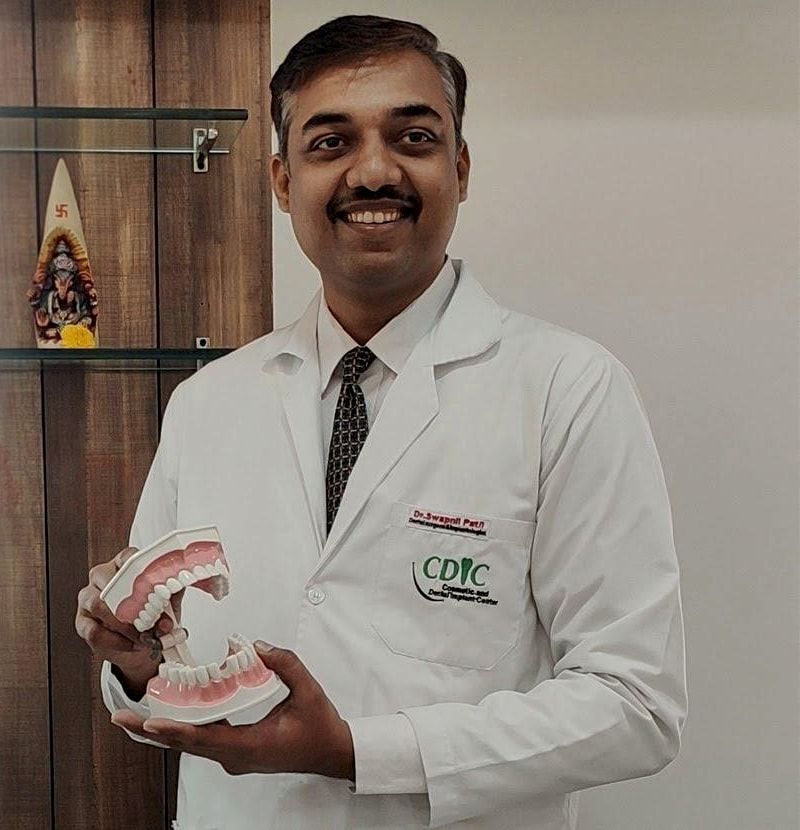
Draft, awaiting review by Dr. Swapnil B. Patil, BDS
A denture that stays put
A standard denture rests on the gums and is held by suction, a little adhesive and the muscles of the cheeks and tongue. Lower dentures in particular tend to float. Implant dentures add two to four implants in the jaw, with attachments on top. Clips inside the denture snap onto them, so it stays where it should while you eat, talk and laugh.
Removable, by design
This is still a denture: you take it out to clean it, and at night. That is part of its appeal. It needs fewer implants than a fixed full-arch bridge, it is simpler to clean, and it often suits jaws with too little bone for more implants, avoiding grafting.
Living with it
The clips wear gradually and are replaced at reviews to keep the grip firm. The gums under the denture change over the years, so it may need relining from time to time. Daily cleaning of the denture, the attachments and the gums around the implants keeps everything healthy.
It may suit you if
- Your lower denture floats, moves or makes eating difficult
- You want a steadier denture without the cost of a fixed bridge
- The bone is too thin for the number of implants a fixed bridge needs
- You would like teeth you can take out to clean
Suitability is confirmed at your examination, never from a web page.
If you would rather wait
If your denture is comfortable enough, keeping it is reasonable. A loose denture can often be relined to fit better in the meantime, though the bone under it keeps slowly shrinking. Planning implants now does not commit you to placing them now.
Step by step
What happens at each stage, and roughly how long it takes. Your own timings are set out in your written plan.
Step 1: Assessment and 3D scan
An examination of the gums and your current denture, and a 3D CBCT scan, taken in-house, to find where implants can go.
Step 2: Placing the implants
Under local anaesthesia, usually two implants for a lower denture and four for an upper one.
Your existing denture is adjusted and softened so you can keep wearing it while the implants heal.
Step 3: Healing
The implants bond with the bone.
Step 4: Fitting the attachments
Attachments are fitted to the implants, and matching clips are set into a new denture or, if it is suitable, your existing one.
Step 5: Reviews
Regular checks of the fit, the gums and the clips, which wear and are replaced from time to time.
What the cost covers
Cost rangeOn request. Ask on WhatsApp for the Implant dentures price range
Included
- The assessment and 3D scan review
- The implants for one arch
- The attachments and clips
Sometimes needed, at extra cost
- A new denture, if your current one cannot be adapted
- Replacement clips as they wear
- Relining the denture as the gums change
Anything extra is explained, with its cost, before it is done.
Risks and recovery
Every treatment carries some risk. These are the ones to know about, and what is normal while you heal.
- New pressure points can make the gums sore at first. Small adjustments fix them.
- The clips wear with use and need replacing to keep the grip firm.
- Food can collect under the denture, which is why it comes out to be cleaned every day.
- An implant can fail to bond, more often in smokers. It is replaced after healing.
Have it at our Wakad clinic
Wakad
Prime City Center, A-6 & B-3, Datta Mandir Road, Shankar Kalat Nagar, Wakad, Pune 411057
Hinjewadi
Our second clinic
Office 102, Adora Commercial Wing, Bhumkar Chowk to Laxmi Chowk Road, Hinjawadi, Pune 411057
What patients say
Read all reviews4.9out of 5
From 578 Google reviews across both clinics, counted in October 2026.
Questions people ask
Not here? Ask us directly. We reply during clinic hours, till 9 pm.
Ask on WhatsAppHow many implants do I need?
Two often hold a lower denture well. The upper jaw usually needs four, because its bone is softer.
Can my current denture be used?
Sometimes. If it fits well and is in good condition, the clips can be set into it. Otherwise a new denture is made.
Do I take it out at night?
Yes. Taking it out lets the gums rest, and it is cleaned out of the mouth every day.
How is this different from fixed full-arch implants?
Implant dentures need fewer implants and come out for cleaning, so they cost less. A fixed bridge stays in all the time and feels more like natural teeth, but needs more implants.
Related treatments
Full-arch implants
Full-arch implants replace every tooth in a jaw with a bridge held by four to six implants. This page sets out the choices, how many implants, which materials, fixed or removable, and when the teeth go in.
Smile in a Day
Smile in a Day replaces a whole arch of failing or missing teeth with fixed teeth on four to six implants. The implants and a fixed temporary set go in on the same day; the final teeth follow once the gums have settled.
Bone grafting and sinus lift
When the jawbone is too thin or too short to hold an implant, a bone graft builds it up. In the upper back jaw, a sinus lift raises the floor of the sinus to make room for new bone.
Questions before you decide?
Call or message us, or ask for a time. We reply during clinic hours, till 9 pm.