
Crowns and bridges
A crown is a cap that covers and protects a weakened tooth. A bridge replaces one or two missing teeth by fixing a false tooth to the teeth on either side of the gap.
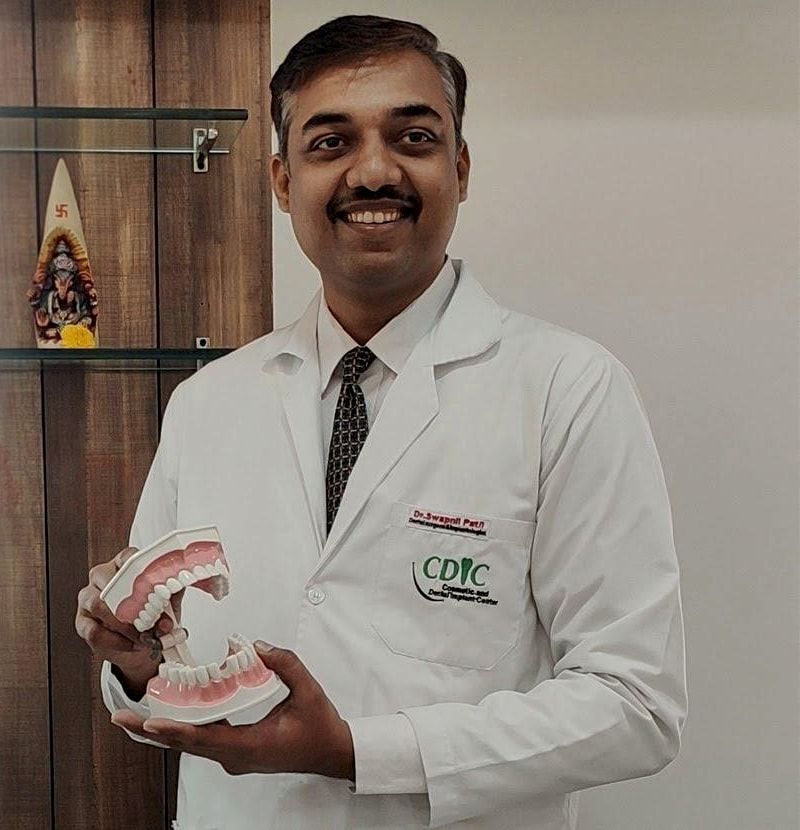
Draft, awaiting review by Dr. Swapnil B. Patil, BDS
Crowns
A crown covers the whole visible part of a tooth, like a close-fitting cap. It holds together a tooth that has been weakened by decay, a large filling, a crack or a root canal, and it restores the tooth’s shape so it can chew normally again. On a front tooth, a crown can also correct its colour and shape.
To make room for the crown, the tooth is reduced evenly by a small amount on all sides. What is left becomes the core the crown is cemented to, so the strength of that core matters as much as the crown itself.
Bridges
A bridge fills a gap of one or two missing teeth. The teeth on either side of the gap are prepared for crowns, and a false tooth is joined between them, all in one piece. Once cemented, it stays in: you clean it in your mouth, not on the side of the sink.
Bridges suit gaps where the neighbouring teeth already have large fillings or crowns, since shaping them costs little extra. Where those teeth are untouched and healthy, it is worth comparing a bridge with a dental implant, which leaves them as they are.
Materials, in plain words
Metal-ceramic crowns have a metal inner layer with porcelain fused over it: strong and long-proven, though a thin dark line can show at the gum over time. All-ceramic and zirconia crowns have no metal, so light passes through them more like natural enamel. Full metal crowns are the most durable and are used on back teeth where appearance matters less.
It may suit you if
- A tooth is weak after a root canal, or held together by a large old filling
- A tooth is cracked, or breaks a little at a time
- Teeth are worn down from grinding
- One or two teeth are missing and the teeth beside the gap are sound
- A single front tooth is a different colour or shape from the rest
Suitability is confirmed at your examination, never from a web page.
If you would rather wait
A cracked or heavily filled tooth can carry on for a while, but cracks tend to spread, and a tooth that splits below the gum may not be saveable. A gap can be left too, though the teeth around it slowly tip and drift into it over the years. If you wait, we watch the tooth or the gap at your check-ups.
Step by step
What happens at each stage, and roughly how long it takes. Your own timings are set out in your written plan.
Step 1: Examination and choice of material
We examine the tooth, take an X-ray, and agree the material with you. Metal-ceramic crowns are strong and tried; all-ceramic and zirconia crowns look more like natural enamel; metal crowns suit hidden back teeth that take heavy loads.
The material changes both the look and the cost. You see the options side by side before choosing.
Step 2: Preparing the tooth
Under local anaesthesia the tooth is shaped so the crown can fit over it, and an impression or scan is taken. For a bridge, both teeth beside the gap are prepared.
Step 3: A temporary crown
A temporary crown or bridge protects the prepared tooth while the final one is made in the laboratory.
Temporaries are not as strong as the final work. Chew carefully on that side.
Step 4: Fitting
The final crown or bridge is checked for fit, colour and bite, adjusted if needed, and cemented in place.
Step 5: Bite check
If the bite feels high in the days after fitting, a short visit adjusts it. A crown should feel like your own tooth within a few days.
What the cost covers
Cost rangeOn request. Ask on WhatsApp for the Crowns and bridges price range
Included
- Preparing the tooth, with local anaesthesia
- The impression or scan
- A temporary crown or bridge
- The final crown or bridge, fitted and adjusted to your bite
Sometimes needed, at extra cost
- A root canal, if the nerve of the tooth is inflamed or infected
- A core build-up or post, when little of the tooth is left
- Gum treatment before starting, if the gums are not healthy
Anything extra is explained, with its cost, before it is done.
Risks and recovery
Every treatment carries some risk. These are the ones to know about, and what is normal while you heal.
- The tooth may be sensitive to hot and cold for a few days after preparation or fitting.
- A temporary crown can come off. Keep it, and call us so it can be put back.
- A crown can chip or loosen over the years, and the tooth under it can still decay at the edge, so cleaning there matters.
- Occasionally the nerve of a crowned tooth becomes inflamed later and needs root canal treatment.
- Food collects under a bridge. A floss threader or interdental brush keeps it clean.
Have it at our Wakad clinic
Wakad
Prime City Center, A-6 & B-3, Datta Mandir Road, Shankar Kalat Nagar, Wakad, Pune 411057
Hinjewadi
Our second clinic
Office 102, Adora Commercial Wing, Bhumkar Chowk to Laxmi Chowk Road, Hinjawadi, Pune 411057
What patients say
Read all reviews4.9out of 5
From 578 Google reviews across both clinics, counted in October 2026.
Questions people ask
Not here? Ask us directly. We reply during clinic hours, till 9 pm.
Ask on WhatsAppDo I need a crown, or will a filling do?
A filling works when enough strong tooth is left around it. When a filling would be larger than the tooth holding it, or the tooth is cracked, a crown spreads the force of biting and protects what remains.
Which material should I choose?
It depends on where the tooth is and how much it shows. Front teeth usually look most natural in all-ceramic or zirconia; back teeth need strength first. We explain the trade-offs and the cost of each.
Bridge or implant for a missing tooth?
A bridge needs the teeth beside the gap to be shaped for crowns, which is a good trade if they already need crowns. An implant leaves the neighbouring teeth untouched but needs surgery and healing time. We lay out both, with costs, for your gap.
How long do crowns and bridges last?
Many last ten years or more with good cleaning and check-ups. Grinding, decay at the edge and gum disease are what shorten their life.
Does getting a crown hurt?
The tooth is numbed while it is prepared, so it should not. Some sensitivity for a few days afterwards is common.
Related treatments
Single-visit root canal treatment
Root canal treatment removes the infected nerve inside a tooth, cleans and seals its canals, and lets you keep the tooth. When the tooth allows, it is done in one visit.
Ceramic veneers
A ceramic veneer is a thin shell of porcelain bonded to the front of a tooth to change its colour, shape or size. It usually needs a small amount of enamel removed, so it is a long-term decision.
Full mouth rehabilitation
Full mouth rehabilitation rebuilds the teeth of both jaws together, usually with a mix of crowns, root canals, implants and bite correction, planned as one sequence so the bite works as a whole.
Questions before you decide?
Call or message us, or ask for a time. We reply during clinic hours, till 9 pm.