
Braces and orthodontic treatment
Braces move teeth into better positions with small brackets joined by a wire that is adjusted every few weeks. They correct crowding, gaps and bite problems, for teenagers and adults alike.
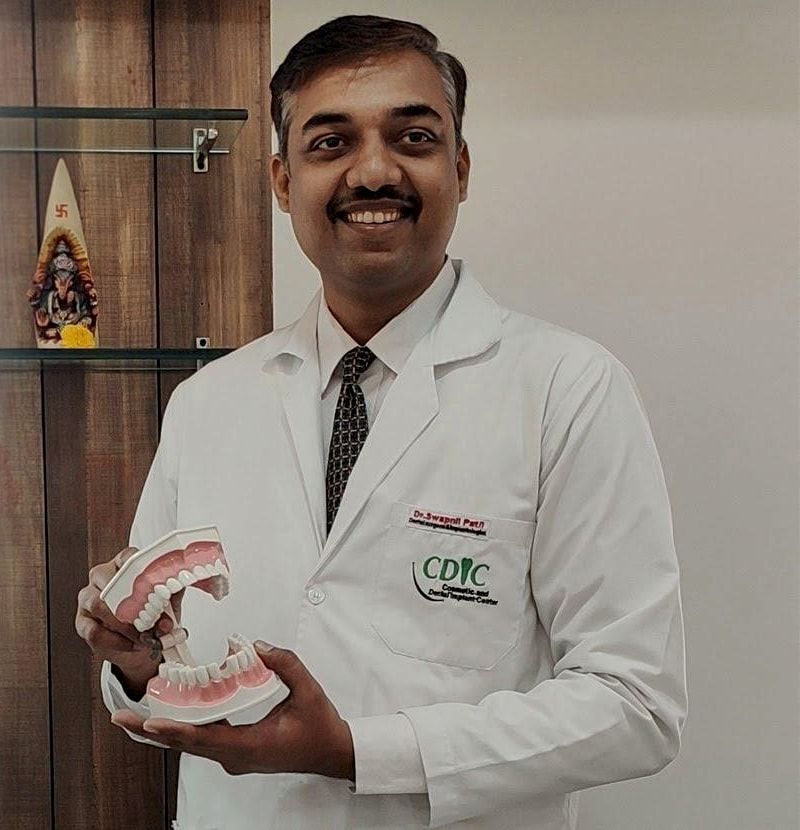
Draft, awaiting review by Dr. Swapnil B. Patil, BDS
How braces work
A brace applies a small, steady push to each tooth. The bone around the root gives way slowly on one side and fills in behind on the other, so the tooth moves through the bone a fraction of a millimetre at a time. The brackets hold the wire against the teeth, and the wire carries the force; changing or bending it at each visit sets the next stage of movement.
It is slow by design. Moving teeth faster than the bone can remodel does them harm, which is why treatment is measured in months and years.
Not only about straight teeth
Crowding and gaps are what most people notice, but the way the teeth meet matters as much. A deep overbite can wear down the lower front teeth; a crossbite can strain the jaw; crowded teeth trap plaque. Correcting the bite makes the teeth easier to clean and spreads the forces of chewing more evenly.
Adults and braces
There is no upper age limit for moving teeth, as long as the gums and bone are healthy. Adults often choose less visible options, such as tooth-coloured or lingual braces or clear aligners, and sometimes combine straightening with crowns or veneers in a smile makeover.
It may suit you if
- Teeth are crowded, overlapping or turned
- There are gaps between the teeth
- The upper and lower teeth do not meet properly (overbite, underbite, crossbite or open bite)
- Crooked teeth make cleaning difficult
- A teenager's adult teeth have come through out of line
Suitability is confirmed at your examination, never from a web page.
If you would rather wait
Crooked teeth are rarely urgent, and if the concern is mainly appearance, waiting is a fair choice. A bite that is wearing teeth down, straining the jaw or making cleaning hard is worth assessing sooner. For children, an early check shows whether the timing of treatment matters.
Step by step
What happens at each stage, and roughly how long it takes. Your own timings are set out in your written plan.
Step 1: Assessment and records
An examination, X-rays, photographs and impressions or scans show how the teeth and jaws sit now. Any decay or gum problem is treated before braces go on.
Step 2: Your treatment plan
The plan sets out which teeth will move, whether any need removing to make room, how long it is likely to take, and the choice of braces.
Ask to compare metal braces, tooth-coloured braces and clear aligners for your case. Each has a different look, comfort and cost.
Step 3: Fitting the braces
Brackets are bonded to the teeth and joined with a wire. The visit takes a while, but nothing is cut or numbed.
Step 4: Adjustments
At each visit the wire is changed or adjusted to keep the teeth moving. Teeth feel tender for a day or two afterwards.
Step 5: Removing the braces and retainers
When the teeth are in place the brackets are removed and the teeth polished. A retainer holds them there while the bone settles.
Retainers are what keep the result. Wear them exactly as advised.
What the cost covers
Cost rangeOn request. Ask on WhatsApp for the Braces and orthodontic treatment price range
Included
- The assessment and records
- The braces and wires
- Adjustment visits during treatment
- Removing the braces at the end
Sometimes needed, at extra cost
- Tooth-coloured brackets instead of metal
- Removing teeth to make room, when the plan needs it
- Fillings or cleaning before the braces go on
- Replacement retainers
Anything extra is explained, with its cost, before it is done.
Risks and recovery
Every treatment carries some risk. These are the ones to know about, and what is normal while you heal.
- Teeth are sore for two or three days after fitting and after each adjustment.
- Brackets can rub the cheeks and lips at first. Orthodontic wax over them helps until the mouth toughens.
- Food and plaque collect around brackets. Poor cleaning leaves white marks or decay on the teeth when the braces come off.
- The roots of some teeth shorten slightly during treatment. It is usually minor; X-rays during treatment keep an eye on it.
- Teeth tend to drift back if retainers are not worn.
Have it at our Wakad clinic
Wakad
Prime City Center, A-6 & B-3, Datta Mandir Road, Shankar Kalat Nagar, Wakad, Pune 411057
Hinjewadi
Our second clinic
Office 102, Adora Commercial Wing, Bhumkar Chowk to Laxmi Chowk Road, Hinjawadi, Pune 411057
What patients say
Read all reviews4.9out of 5
From 578 Google reviews across both clinics, counted in October 2026.
Questions people ask
Not here? Ask us directly. We reply during clinic hours, till 9 pm.
Ask on WhatsAppWhat is the right age for braces?
Many children are treated between about 10 and 14, when the adult teeth have come in and the jaws are still growing. Teeth can be moved at any age, though, and adults make up a large share of people having braces.
Will teeth need to be removed?
Only when there is not enough room to line the teeth up without pushing them too far forward. Your plan says whether it applies to you, and why.
Metal braces, tooth-coloured braces or aligners?
Metal braces are the most robust and cost least. Tooth-coloured brackets are harder to see. Clear aligners are removable and nearly invisible but depend on you wearing them 20 to 22 hours a day. The right one depends on the movements needed.
What can I eat with braces?
Most things, cut into small pieces. Avoid hard and sticky foods such as nuts, ice, toffee and chewing gum, which bend wires and break brackets off.
How long will I wear a retainer?
Full time for a period after the braces come off, then usually at night for the long term. Teeth keep a tendency to move throughout life.
Related treatments
Clear aligners
Clear aligners are a series of thin, removable plastic trays, each shaped to move your teeth a little further. You change to the next set every week or two until the teeth reach their planned position.
Invisible braces
Invisible braces are fixed braces that are hard to see, either bonded behind the teeth where they are hidden from view, or tooth-coloured brackets on the front. Unlike aligners, they stay in all the time.
Smile makeover
A smile makeover brings several treatments, such as whitening, aligners, veneers, crowns or implants, into one plan, in an order where each step sets up the next.
Questions before you decide?
Call or message us, or ask for a time. We reply during clinic hours, till 9 pm.